


MODULE FIVE
REFRAME
COACHING CALLS
Module 5 - Beta Round
Module 5 - May 2019 Round
To watch coaching calls for this module, enter the password ‘inspired’ above
“The place where you are right now, God circled on a map for you”
“Each time since early childhood when we stopped the flow of energy in a painful event, we froze that event in both energy and time... That part of our psyche remains frozen until we thaw it out. It does not mature as we do. If the event happened when we were one year old, that part of our psyche is still age one. It will continue to be one year old and act as a one-year-old person when evoked. It will not mature until it is healed by getting enough energy into the block to thaw it and initiate the maturation process”
“Consider for a moment that what you call your ‘personality’ is actually just a composite of habits and behavioural patterns you developed to cope with trauma. Now ask yourself, ‘Who am I oustide of my pain? Who would I be if I stopped living life as a product of my story?’”
“Let go of your story so the Universe can write a new one for you”
“By giving me a name, a label, you negate all the other things I could possibly be”

EXERCISE 1: HEALING YOUR INNER CHILD
Most of us would never, ever speak to a child the way we speak to ourselves, criticising and judging and blaming...
But we were all once children, and we still have that child dwelling within us. We've generally spent our adulthood ignoring and neglecting our inner child. We have been told by society to 'grow up', pushing our inner child-like wonder, innocence, joy, sensitivity and playfulness aside. Your inner child holds onto all of your accumulated childhood pain, abuse, hurts, trauma, fears, anger, guilt and shame. The little girl still within you has been craving love and acceptance, but instead feels abandoned and rejected.
Our parents did the best job that they could at the time, with the awareness that they had. They're only human. If your relationship with a parent didn't give you what you needed, wanted or expected, now is your chance to consciously re-parent yourself.
If you have experienced a difficult relationship with a parent or guardian, you might want to write a list of what an ideal parent would look like to you. Think about what you saw in other parents that you wished you had. This may bring up hurt and disappointment; that's okay. Feeling our pain is essential if we are to heal it. Even thinking about writing a list essentially highlighting your parent's shortcomings may trigger guilt, shame and fear in you. That's also okay. Know that your feelings, wants and needs are unique to you, and you do have the right to express them and to heal them. You are writing the list as an act of self-love, not to hurt anyone. If you need to release those feelings so you can write the list, use the EFT/tapping exercise from Module 3 - Release.
Until we acknowledge and heal our inner child, we are essentially children in adults bodies - it is a hurt, terrified little girl or boy calling the shots and directing your adult life. She or he feels anxious, lonely, afraid, inferior, lost and insecure, and overwhelmed at having to fend for herself in an 'adult' world without protection and support. She or he is emotionally wounded and deeply hurting, and needs your love, acceptance and care.
Here’s how you can heal your inner child:
>>> Acknowledge your inner child. Tell her or him - either in your mind or out loud - that they are going to be okay. You're here for them now. You love them, and you will never let her or him down. Tell them that they did their best; they didn't deserve what happened; you are listening to her or him and will look after them. Speak to yourself just as you would a small child, with compassion, gentleness and understanding.
>>> Use the H'oponopono exercise (from Module 3 - Release) with your inner child. Tell her or him: I forgive you, I'm sorry, thank you, I love you. Hear them saying the same to you: they forgive you, they’re sorry, they thank you and they love you.
>>> Practice tuning into what your inner child needs throughout the day. Does she or he feel safe? Loved? What actions does she or he want you to take? Continue telling them all the loving things that they need to hear.
>>> Consciously make time for play. What did you love to do when you were younger? Drawing, painting, dancing, running, building Lego, riding a bike, reading? Bring some of those activities back into your adult life.
>>> Write a letter from adult you to younger you, expressing love, support and empathy.
>>> Practice meditations in which you visualise and connect with your inner child. YouTube is a good place to find guided meditations - just use the search function and find a meditation that resonates with you.
>>> Parent yourself responsibly. Pay attention to what your body feels and needs. Be sure you are honouring your basic needs: enough sleep, nutritious food, structure that makes you feel safe, time with people who uplift and support you (staying away from environments that are toxic or triggering).
>>> You might like to use prompts/reminders in order to focus on inner child healing, such as putting a photo of little you somewhere you will see it. A friend of mine actually carried a small doll around in her pocket for awhile, to remind her of the presence of her inner child. You could set a regular reminder to pop up on your phone, or carry a slip of paper with a prompt on it in your wallet or pocket. (When it becomes available, check out the information on 'anchors' in Module 6 - Reinforce for more suggestions.)
>>> Include your inner child when you ‘tap’/do EFT (covered in Module 3 - Release), as I do in the videos below:
Video 1: EFT for healing the effects of having a critical, judgemental parent
Video 2: EFT for healing from feeling abandoned or neglected by a parent

EXERCISE 2: EXAMINING YOUR ‘IDENTITIES’
We all tell ourselves ‘stories’ about ourselves. As humans, we naturally assign ourselves ‘identities’ based on our life experiences.
These identities can serve the purpose of allowing us to make sense of our selves within the world around us.
However, they can also limit us and keep us ‘stuck’.
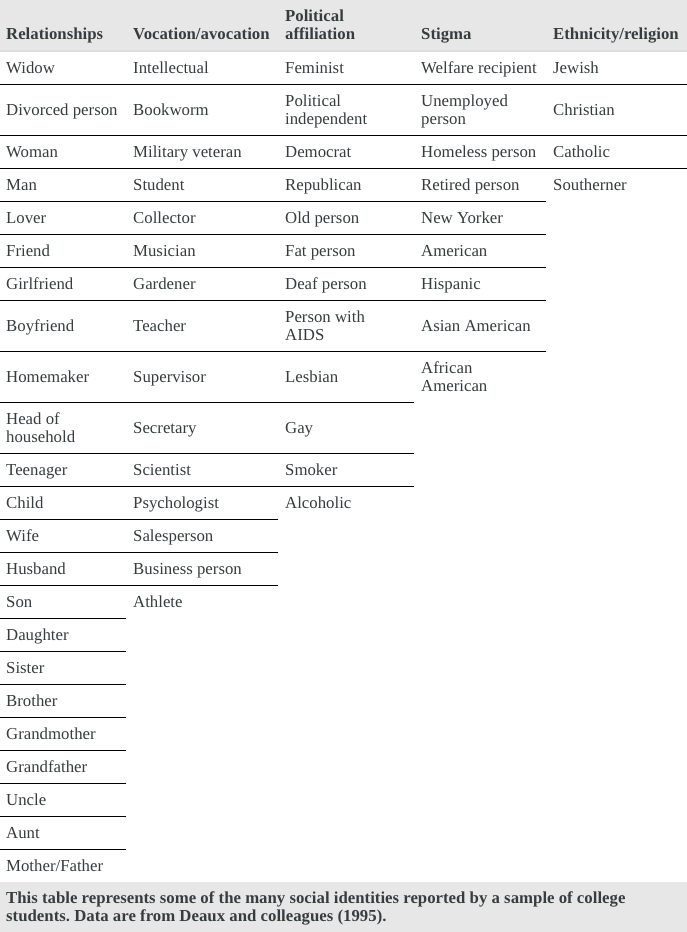
Here are some of the self-reported ‘identities’ of college students in a 1995 study:
As a teenager, I dated someone who didn’t manage money well. For a long time, he was unemployed. I worked two jobs - a trainee at a dental practice during the day and a waitress at Hog’s Breath Café at night - supporting both of us financially. Despite paying two lots of rent plus bills, and earning a very low hourly rate, I managed to save several thousand dollars. It seems an impossible thing to have done, but I had a dream I was completely dedicated to: my very first overseas trip.
Yet the longer my boyfriend was unemployed, the more challenging keeping up with all our expenses got. While I covered our rent, bills and joint loan repayments, he was supposedly making his car loan repayments.
It wasn’t long until the car was repossessed.
The overdue repayments plus additional fees to release the car from the impound lot was thousands of dollars. But he “needed” that sports car “to get to job interviews”; and I was unconditionally supportive and assisting him in every way I could.
To get his car back, I had to withdraw most of the money I had saved for my trip. We went into the bank together for me to get the money out. As we left, I gently mentioned that I’d rather have not had to withdraw that money because I’d been earning interest on it. I recall the exact look on his face, the way he scoffed as he told me that was a dumb thing to consider because the interest was “fuck all” anyway and I was wasting my time saving.
We all have stories. Not stories in the sense of a recount of events, a tale; but “stories” that we create because of events. In the incident above, I let the way I felt in that moment leaving the bank define my subconscious beliefs about money and myself for the next 15 years. That may sounds ridiculous, but it’s likely that you have done the same, in so many areas of your life.
We allow stories about our past define who we are in the present and who we will be in the future. Often we have let the stories become an integral part of our identity. As a result, letting it go can be confronting and scary. Without that story to define us, we fear we will lose who we are. However, we have to be willing to let go of our stories in order to grow and heal. We must question and shift our perception of the experiences we've had.
The facts of the story above are that I loaned someone money to assist them; someone who happened to have different ideas and behaviours related to money than what I did.
But the conclusions I subconsciously drew from that situation were things like this:
‘It’s uncool/shameful/embarrassing to care about your finances’
‘When it comes to money, I’m stupid and know nothing’
The identity I subconsciously took on was of someone who is not good with money.
The conclusions that we’ve drawn often seem silly and illogical when we bring our awareness to them, but they are very, very real to our subconscious minds. Those conclusions became our beliefs, which become our thoughts, that result in feelings and behaviours, creating the external circumstances we have in our lives today.
The conclusions I drew in this case resulted in years and years of financial stress for me, stuck in ‘the struggle cycle’, living pay to pay, never quite having enough money to make ends meet – let alone save.
Acknowledging your past pain related to your parents and upbringing is important, and that’s why we do it in other modules of this course.
However, when any suppressed emotions have been processed in a healthy way, you must become aware of where you are thinking using self-created, limiting identities - especially that of ‘the victim’.
A victim mentality is very common. Once you become aware of it, you will notice people around you are operating within that identity and mindset much of the time.
When someone is thinking as a victim, they blame something outside of themselves for all of their situations and challenges. They rationalise and justify why someone or something else is the cause of their issue. They are not willing to take responsibility. They view aspects of their life as negative and beyond their control… and this means that they are giving away their innate power to control their reality. As they believe that they have little power to change things, they take little action to improve their problems.
Someone thinking with a victim mentality may develop convincing and sophisticated explanations in support of such ideas, which they then use to explain their situations to themselves and to others.
We want to become aware of when our thinking is restricted or limited by a certain identity or mentality. Notice the words you use to describe yourself. They can support your expansion, or they can restrict what you feel is possible.
For example, if you have accepted an identity of being ‘a klutz’ and you constantly say, ‘I’m always so clumsy’ - that is a self-fulfilling prophecy. You are not able to create anything other than that.
If you notice that you identity yourself as ‘a tomboy’, consider how that might restrict you. For example, a ‘tomboy’ might never wear dresses or allow themselves to embrace the feminine aspects of self like pleasure-seeking and pampering themself.
If you have been telling yourself that ‘you’re not a bookworm’, or ‘I’m not someone who reads’, you are entrenching not reading as the norm and there is no scope for change in that area.
If, as I was, you are telling yourself you’re ‘not good with money’, or you’re someone who is always in debt… you’re giving away your power to create change in that area of your life.
Spend some time meditating and/or journalling on these questions:
>>> What identities are you aware you have taken on?
>>> How are these impacting what is possible for you in your life?

EXERCISE 3: AN ATTITUDE OF GRATITUDE
Everything in the Universe is made up of energy, vibrating at different frequencies.
Gratitude has a high vibrational frequency. Feeling grateful raises the vibration of our energy field, elevating our mood, increasing our manifesting power, improving our life experience...
Taking a moment each day to get present to what you are grateful for in your life makes an enormous difference to your level of happiness and the speed at which you’ll reach your goals. When you appreciate who and what you have around you, this raises your vibration, which in turn, immediately begins attracting more abundance to you in the form of new positively charged people and golden opportunities that will help you reach your goals!
One of the best ways to cultivate an attitude of gratitude is to start up the habit of writing in a gratitude journal. Keep a notepad or journal beside your bed and, before you sleep each night, take a few minutes to think of and write down 5 things that you feel grateful for that day. After just a few days, you’ll begin developing your ‘gratitude muscle’, and you’ll find that it becomes easier and easier to think of things you’re grateful for in any given moment!
You can be thankful for little things or big things. You can be thankful for absolutely anything...
'I'm grateful for all the fresh air that I've taken into my lungs until now. There is an abundance of air on planet Earth and I am freely enjoying it. Thank you! I love breathing! And thank you for all the food that my body has been blessed with so far. The Earth is good and kind and has nourished me greatly. I love living on this beautiful planet!'
When I'm in a funk or in a bad mood, I always challenge myself to list five things that I'm grateful for. Sometimes my inner critic will resist, protesting that 'It's stupid' and saying, 'Piss off, I don't want to'. In this case, I literally hold up one of my hands in front of me with five fingers outstretched, and firmly but lovingly tell myself: "C'mon, you can do it. Just five things!" and then I put down a finger for each thing I find to be grateful for (I can’t ignore the hand right in front of my face!). Even though I’m grumpy doing it initially, the practice shifts my vibration so quickly and I feel happier and empowered!
So… what are you thankful for right now?
(Check out 30 Trillion Reasons to Be Grateful: An Ode to the Awesome Human Body by Joel Almeida for some inspiration)